




Customer service opens WhatsApp in the morning. One customer complains in English about a logistics delay, another sends a Spanish voice message asking about sizes, and a third asks in Arabic whether samples can be sent first. Within three minutes, three decisions must be made: who to reply to first, what language to reply in, and whether to keep a record of this message. Translation tools can solve the problem of “understanding,” but they cannot solve “replying in the wrong language,” “commitments not recorded,” or “the next shift having to translate it all over again.” To handle translation needs in WhatsApp customer communication, the core is not to find a button, but to first distinguish which layer the translation happens at, and then verify it according to the process.
First, Distinguish: Translation Needs in Customer Communication Are More Than “Understanding One Sentence”
The same statement, “the customer sent a message in a foreign language,” actually corresponds to three different tasks in the customer service workflow. Handling them together leads to situations such as “translated but did not reply,” “replied but the customer did not understand,” and “understood it but lost everything during handover.”
- Reading Messages:The goal is to accurately understand what the customer is saying. The focus is on whether language identification is correct, whether non-text content such as voice messages and images is covered, and whether negations and numbers have been translated in reverse. If this layer goes wrong, all subsequent replies are invalid.
- Writing Replies:The goal is to express things clearly in a language the customer can read. The focus is not on elegant sentences, but on short sentences, consistent terminology, and whether key information such as prices, dates, delivery lead times, and return conditions is consistent with the original text.
- Follow-up:The goal is to keep the context from being lost. The focus is whether the language the customer uses, what has been promised, the next steps, and the owner remain in the same customer record, rather than being scattered across an individual support agent's private chat window.
The key checks for these three types of tasks are completely different. If you reply as soon as you understand the message, it is easy to miss commitments; if you only set up translation and ignore records, you will still have to start over during handover. For more detailed scenarios involving individual messages, voice and images, and multi-person multilingual situations, refer toHow to translate foreign-language messages received on WhatsAppfor its classification-based handling approach.
For automatic translation settings, first determine the layer: mobile OS, browser assistance, or an aggregation workbench.
Many people look for an 'automatic translation master switch' in WhatsApp and cannot find one. WhatsApp does not have a unified translation entry point that covers all scenarios; translation capabilities depend on the layer you are at. First determine which layer the team mainly works at, then discuss settings—this is more effective than installing plugins blindly.
| Setting location | Suitable scenarios | Items to check after setup | Boundaries |
|---|---|---|---|
| Translation built into the mobile OS or input method | Personal accounts, low message volume, and mainly text messages | Whether the target language is fixed, whether translations return to the original chat, and whether voice can be handled | When switching between multiple accounts frequently, it is easy to reply in the wrong window; images and voice often cannot be processed directly |
| Browser page translation or plugins | Desktop WhatsApp Web, temporary viewing of long messages | Whether it stops working after refresh, whether only the visible area is translated, and whether the input box content is rewritten as well | Usually does not modify the messages themselves; team collaboration and record-keeping still need to be handled separately |
| A workspace that aggregates multiple social accounts | Multiple accounts, multi-person co-management, and the need to keep translations and customer records together | Language settings for each account, whether translations and originals are retained at the same time, and whether records follow the customer | It requires unified team configuration and acceptance; it cannot be considered complete just because one person has set it up |
SKY SCRM is an example of the third category of tools: it puts multi-account management for global social platforms, AI translation, and customer management into the same workflow. Specific menu paths are not included here because interfaces change across versions; a more reliable approach is to conduct an acceptance check based on the checkpoints below. If the team is still in the selection stage, you can first look atBefore recommending WhatsApp chat translation software, check these points firstthe criteria for making that judgment.
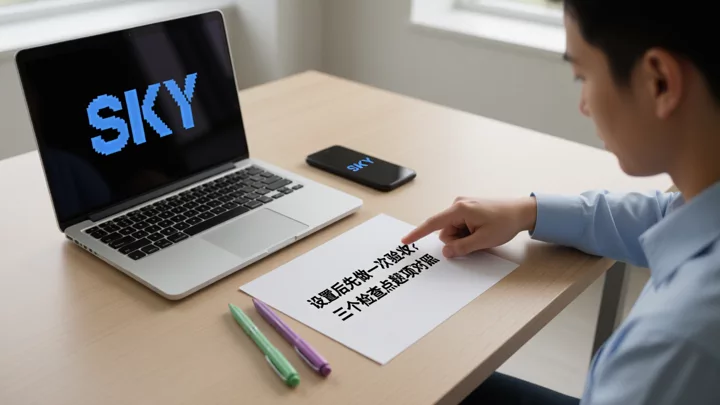
Setup check diagram: three validation points determine whether the translation can be used directly in a reply
Seeing a translation appear does not mean setup is complete. For the first acceptance test after setup, it is recommended to test with a real but low-risk customer conversation rather than trying it with blank messages. Perform the following three checkpoints in order; if any one fails, do not send the translation directly yet.
- Is language detection correct:When a customer mixes English and Spanish or uses expressions with dialectal features, the tool may detect only one of them. Confirm that the primary language it translates matches what the customer actually wrote, rather than force-translating a mixed-language message as a single language.
- Is the source text retained:The source text must be visible next to the translation, especially for numbers, model numbers, addresses, and negative sentences. If there is only the translation and no source text, there is no way to review it, and handovers cannot determine whether the translation is correct.
- Can key fields be verified:Fields such as price, quantity, date, delivery date, color, and size should be compared with the source text one by one. A fluent translation with misplaced numbers is one of the costliest types of errors in customer communication.
Multilingual replies: decide the reply language first, then handle the sentences
The reply language should not depend on the customer service agent's mood that day. The team needs a clear rule; otherwise, the same customer may receive replies mixing Chinese, English, and Spanish, and the customer will wonder whether they are even talking to the same person.
- By default, follow the language of the customer's incoming message.If the customer asks in Spanish, reply in Spanish; if the customer switches to English midway, the reply should switch accordingly. Only reply in Chinese when the customer takes the initiative to use Chinese.
- For mixed languages, use the language of the main request as the standard.When a customer makes small talk in English but states specific requirements in Spanish, reply in the language of the segment where the request is made, and if necessary, confirm at the beginning with one sentence in the customer's other language.
- Keep sentences short; say only one thing per message.Long sentences and multiple subordinate clauses are where subjects and conditions are most easily lost in translation. Splitting 'if payment is made before Friday, we can ship next Wednesday; otherwise it will be delayed' into two sentences is less error-prone than translating the whole paragraph.
- Keep terminology consistent and build a small glossary.For product names, model numbers, sizing systems, who bears shipping costs, and return/exchange conditions, fix one translation within the team. If different customer service agents each use their own version, customers will think they are different policies.
Before sending a reply, check at least four types of content: numbers and units, dates and deadlines, negations and conditions, and commitments. These four items do not depend on translation quality; they depend on whether the person sending the message takes one more look. In multi-person, multilingual group chats, this also involves who is responsible for replying and who only takes notes; you can refer toHow to manage multilingual messages in WhatsApp group chatsthe division-of-labor approach within it
Follow-up is not translating again: put the original text, translation, and next step in the same customer record
The most common waste during shift handover is that the next colleague opens the chat history and has to figure out from dozens of messages what the customer is waiting for. If translation only happens in a personal window, this judgment has to be redone, and may not lead to the same conclusion. What really needs to be kept in the follow-up stage is not the entire chat, but a summary that lets someone else continue the work.
The record should at least answer four questions: what language the customer prefers, what has been confirmed in this round of communication, what remains unconfirmed, and who will do the next step and when. The original-text summary only needs to keep a few key sentences, not a full copy; place the translation alongside for quick reading; write commitments separately and clearly so they are not buried in long paragraphs and overlooked. There should also be an agreement on who updates this record, usually the customer service agent who last replied to the customer, completing it when ending this round of communication.
Another additional risk when running multiple accounts in parallel: the same customer may come in from different numbers, or a customer service agent may have several accounts open at the same time and switch to the wrong reply window. Records that follow the customer rather than the window can significantly reduce such errors. For specific practices on multi-account aggregation, you can read furtherHow SKY SCRM implements automatic WhatsApp message translation and multi-account customer management.

Example follow-up record fields: so the next colleague on shift does not have to guess from scratch
The fields do not need to be many; just enough is fine. A workable combination is: customer language, original-text summary, translation key points, key commitments, items to be confirmed, next action and owner, and last updated time. The first four help understand the context; the last three directly determine whether the person taking over needs to ask again.
Avoid turning records into a chat log backup. Copying large blocks makes people reluctant to read them, which defeats the purpose of a summary. It is also not advisable to write only the translation without the original summary, because the translation itself may contain deviations, leaving nothing to compare against during later review. The value of a record lies in being "brief and accurate," not "complete."
Do not let automatic translation go directly to the other party in these situations
Automatic translation is suitable for handling high-frequency, low-risk, structurally simple messages. In the following scenarios, the translation can only serve as a reference; someone must review it before sending, or you should first confirm with the customer using the original text.
- Voice and image messages:Voice involves accents and background noise, and specification tables, handwritten addresses, and text in screenshots are even less something ordinary text translation can handle reliably. Convert them to text and confirm the content first, then decide how to reply.
- Quotes, contract terms, delivery commitments:Once these are mistranslated, the cost of explaining afterward is far higher than spending an extra five minutes on manual verification. Numbers and conditions must be checked item by item against the original, and the original terms should be attached when necessary.
- Slang, jokes, emotional complaints:Tone is extremely easy to distort in translation. When a customer is upset, a blunt literal translation may be taken as a brush-off. For these messages, it is advisable to write the reply manually, or first confirm your understanding is correct with a single sentence.
- Multi-person, multilingual group chats:A single reply will be seen by everyone in the group, and both the language choice and the intended recipient are easy to get wrong. First confirm who this reply is for, then decide which language to use.
- Multiple accounts online at the same time:When switching windows, it is easiest to send a reply meant for Customer A to Customer B. Before sending, glancing at the customer name and language at the top of the chat window is a very low-cost habit.
If the team is comparing whether different solutions can cover the entire chain of “translation—multi-account—customer management,” you can refer toHow to choose a WhatsApp multilingual communication solutionthe evaluation dimensions in it, test with a small sample of conversations first, and then decide whether to expand the scope of use.
Frequently asked questions
Can WhatsApp's built-in translation handle voice and images?
There is no one-size-fits-all answer, and do not assume that a single automatic translation entry point exists. Voice needs to be converted to text first, and text in images needs to be recognized first; these two steps are usually not completed within the chat window. For customer messages involving voice and images, it is advisable to first compile them into text and confirm with the customer before moving to the reply stage.
When multiple accounts are online at the same time, how can you avoid sending a reply to the wrong customer?
Before sending, confirming the customer name and their commonly used language at the top of the chat window is the most direct check. At the team level, customer records should follow the customer rather than a particular account window; this way, even if someone else takes over, the records show where the previous round of communication stopped.
If a customer writes in a mix of English and Spanish, which language should the reply use?
Look at which paragraph the customer writes their main request in. If they use English for greetings and Spanish for specific requirements, reply in the language in which the request was made; if the two languages each account for half and both are important, you can reply in the language the customer used most recently, and briefly confirm at the beginning whether your understanding is correct.
Why can’t quotations and lead times rely directly on automatic translation?
Because the cost of errors in this type of content is asymmetric. If a greeting is translated awkwardly, the customer may at most find it unnatural; if a lead time or price is translated incorrectly, it can directly lead to an order dispute. Numbers, units, conditions, and negative statements must be checked item by item against the source text, and when necessary, the source text should also be sent to the customer for confirmation.
To what level of detail should customer records be kept during handover?
Keep them detailed enough that the next shift colleague can continue replying without scrolling back through the chat history. This usually includes the customer’s language, what has been confirmed in this round, items still pending confirmation, and the next action and owner. Retain a few key sentences from the source text and write the key points in the translation; there is no need to copy the entire chat history.